

The Textile Society: Future Advocacy and Activism
Saturday 10 October 2026
11am to 4.30pm
Registration from 10.15am
The Art Workers’ Guild
6 Queen Square, London WC1N 3AT
Textile Society members, please purchase your ticket here on Eventbrite.
Non-members, to attend and engage in the conversation, please join the Textile Society to purchase your ticket on Eventbrite.
Presenters
Dr Beverly Ayling Smith
Eleanor Burkett
Jan Connett
Portia Dadley
Elizabeth Gaston
Lucie Hernandez
Ruth Lloyd
Hester Mauduit
Mabel Okuta
Sarah Pardoe
Ruth Singer
Louise Surowiec
Dr Angharad Thomas
Professor Freddie Robins
Meredith Wood
Moderators
Dr Linda Brassington (Chair)
Professor Emerita Lesley Millar MBE
Dr Joanne Horton (Vice Chair)
The Textile Society is a broad and active constituency with considerable expertise and knowledge across its membership. As such, it is important that the Society reflects the aims, ambitions and practices of its members, and inspires and attracts new members in the future. Since 2021, the Society membership has increased from approximately 350 to 900+, elevated the status of its awards and bursaries, and raised the quality of design for its publications and website. All of these provide an excellent platform for development.
To ensure that the Society continues to promote the study of textile disciplines, both traditional and contemporary, this research symposium highlights Advocacy and Activism as a key focus for the future. The schedule introduces a programme of diverse position papers with time for members to discuss the ideas presented.
The outcomes from the day will be way-markers for the Textile Society.
This is a unique opportunity for members to shape the future.
We look forward to seeing you.
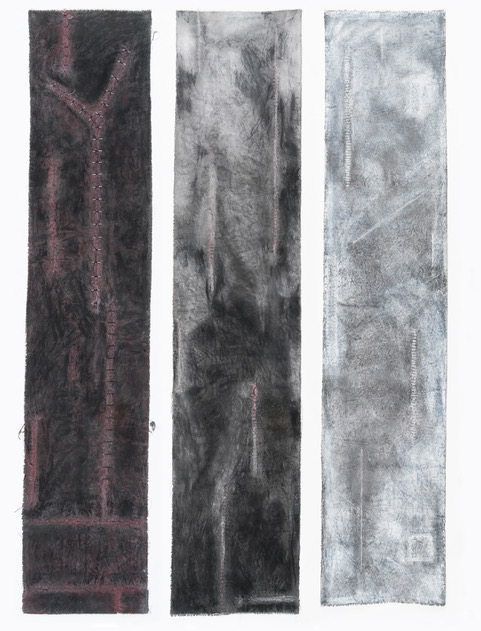
Dr. Beverly Ayling-Smith
I am an artist and researcher, my practice-based PhD examined how cloth can be used as a metaphor for loss and how it can connect with the emotions of the viewer. My work explores how domestic textiles can be used to express emotions particularly of loss and grief using techniques such as staining, tearing and mending. I have exhibited widely in the UK and internationally; my work is in the Whitworth Art Gallery collection and in Visions Museum of Textile Art and other collections in the USA. I have presented my research at international conferences and had my research published in the UK.
Cloth and well-being
It has been established for some time that cloth, stitch and making has a positive impact on mental health (Wellesley-Smith, 2020) and can also be used to act as a metaphor for the emotions of loss and grief (Ayling-Smith, 2019) enabling a space to develop resilience and the work of processing feelings. Enclothed cognition, where the symbolic meaning of garments impacts the wearer’s mood and the emotional memory held within cloth both domestic and in fashion is well documented (Patel and Singh, 2025).
Emotional intelligence, with its underlying pillars of self-awareness, self-management, social awareness and empathy is a learnable skill which can help with managing stress, accepting criticism, preventing burnout and identifying emotional triggers.
I propose that one of the priorities of the Textile Society would be the setting up of a working group to develop the relationship between cloth and emotions with the promotion of the importance of cloth and stitch in emotional intelligence, mental health initiatives and the well-being of all people.
The Textile Society has members who are experienced in developing and running community projects, exhibitions and workshops who could, with the support of the Textile Society, be instrumental in raising the awareness of cloth in well-being to a wider audience and be visible advocates for textile practice in this area. A symposium on the subject could attract attendees and presenters from a wide range of social organisations and support groups. This would establish the Textile society as the centre of excellence for information, resources and expertise for those wanting to find more information about cloth and well-being.
References
Ayling-Smith, B. (2019) Connecting with the viewer: affectivity and cathexis in textile artwork TEXTILE, 17:3, pp296-311,
Patel, R and Singh, K.N. (2025) The Psychological Impact of Clothing on Mental Status
International Journal of Science Academic Research, 06:2, pp.9396-9399, Wellesley-Smith, C. (2020) Resilient Stitch London: BT Batsford Ltd
Outline
Proposal for the Textile Society to create a working group to advocate for the importance of cloth in mental health and well-being. Using resources available to the Textile Society – expertise, experience and presence in the world of textile art and research, this could create a centre of excellence for this field.
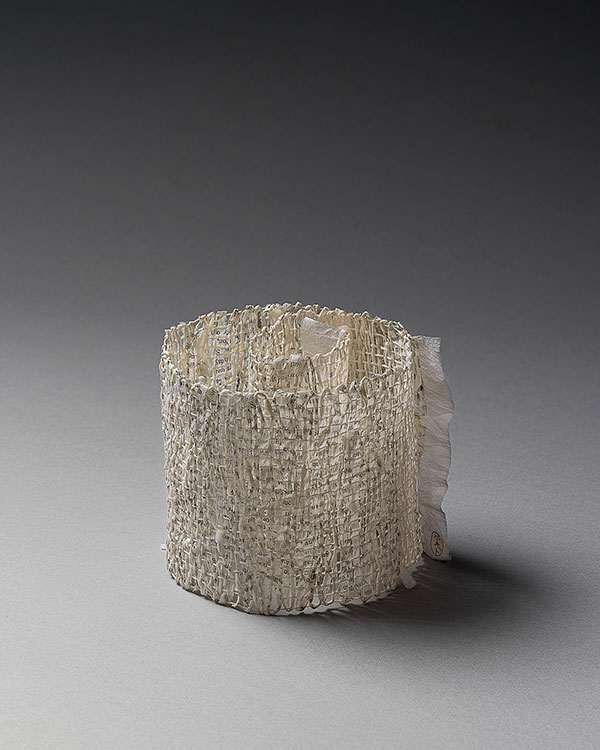
‘The Deep North’
Handwoven paper thread made from a 1964 leaflet outlining the paper-textile processes of shifu and kamiko
Eleanor Burkett
Photo credit: David Brunetti
Eleanor Burkett
After graduating from a Fine Art textiles course at Goldsmiths College I had an extended period living in NE Japan. My research and focus centres round the dwindling number of papermakers and craftspeople who support or practice historic paper-textile techniques of the region. In 2023 I authored a limited edition book entitled ‘Washi Memories’ (The Old School Press) with the assistance of former papermakers from the village of Kamikawasaki. It offers a record of a bygone era, whilst the focus of my textile work draws upon their knowledge and skills to provide a contemporary response to their endangered processes.
Examining essential values in the study of traditional disciplines
Eleanor advocates for a deep understanding of traditional textile disciplines to understand the voices of knowledge holders and the skills and knowledge they transmit. Artists’ contemporary response is crucial in this process as endangered traditions are given contemporary relevance and meaning.
45 years ago, whilst a textile student living in Fukushima, North East Japan, I witnessed an active, albeit declining, rural papermaking industry with a thousand-year-old history. Today, papermaking in the area is an endangered practice. Japan is known for its respect for traditions, yet year after year as key knowledge holders pass away in remote areas and with no successors, a wealth of knowledge and skills also vanishes. Despite Unesco-protection of 3 papermaking regions of Japan, changes in lifestyles and in the role of paper within cultural life have eroded an ancient craft which once shaped individual, collective and national identity. This situation is not unique to Japan but replicated the world over.
I advocate for a change in perception, one not based on nostalgia for a bygone age, but one which distils the essential values embedded in the crafts. A connection to landscape, community and materials through sustainable practice, and making as a way of being, is of as much relevance as it was in the past. To this end the Textile Society can use and develop its platform to challenge and encourage contemporary relevance to deep-rooted skills we are in danger of losing. Through my own practice, exhibitions and workshops, I am campaigning to keep paper-related disciplines and precious traditions relevant. Partnering with the Textile Society to strengthen links within education and training, and offering opportunities for members to engage in debates about the role of textile and craft disciplines with key and partner organisations offers a way forward.
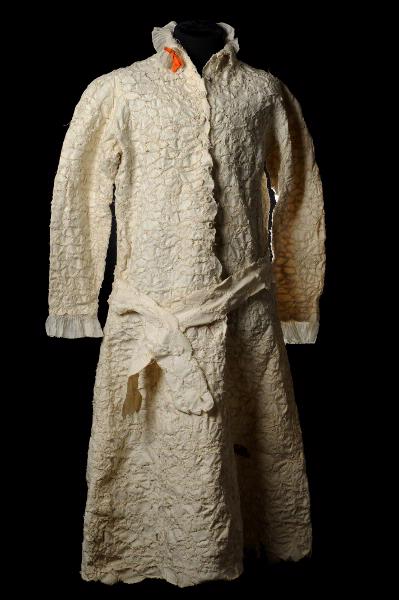
Patchwork dress made from torn medical swabs, Lund Asylum, c1900
Photo credit: Region Skåne’s Medical History Collection
Jan Connett
I am a researcher, textile artist and 2nd year PhD student at Manchester Metropolitan University investigating the potential value of ‘flow-state’ creative textile-making to women’s mental wellbeing, using collaborative and interdisciplinary methods. I am particularly seeking to learn from surprising elements of textile practice in nineteenth century ‘lunatic’ asylums. My professional background is in community development, adult social care and public health, but my favourite post was very practical, teaching C&G Design and Embroidery, whilst exhibiting nationally and internationally. I initially trained and worked as an engineer, have built a house and cycled solo across Europe.
In Stitching and in Health
I am interested in storytelling through cloth. My starting point is textiles created independently by women patients in c19th ‘lunatic’ asylums. As well as stitching, tearing (of clothes and bedclothes) was common. And despite their diametrically opposed dynamics and material outcomes, I propose both these processes as purposeful, meaningful activities, with potential to benefit patients’ mental wellbeing and the management of the institution.
My practice-research integrates archival investigation with my own textile practice: a symbiotic partnership of ‘thinking through making’ and ‘making through historic inquiry’. What can textile artefacts left behind by historic women patients tell us about their lives? And how can I add to our understanding of their situated stories: their processes, intentions and mental health affect, through the empathetic making of new, provocative textile pieces?
This study establishes the culture of independent textile making, unmaking (tearing) and remaking in one asylum in Lund, Sweden, in the context of Moral Treatment for mentally ill patients, where work was recognised for its therapeutic value and as an instrument of behaviour management. Extant c19th patient-made textiles are rare, so the availability of a rich archive at Lund, attributing makers’ names to specific pieces, is crucial. Case notes and asylum reports provide insight into patients’ situations and the institution’s ethos, culture and routine. However, there is a dearth of patients’ firsthand accounts. In the absence of their direct voices, I make novel use of phenomenology (analysing textiles and writings to understand patterns of sense-making), close reading of documents and artefacts and application of material culture and physical engagement theories. Elements of autoethnography allow me to reflect on my own response to these contrasting textile processes.
These explorations aim to provide insight into c19th patients’ self-care through textile-making, asylums’ roles in facilitating these processes and implications for mental and emotional wellbeing today. I propose The Textile Society supports partnerships between researchers, textile artists and museums whose collections include patient-made textiles. The purpose of these partnerships being to promote projects that use the stories of those artefacts and their makers to engage a wider public in innovative, supportive textile-making and conversations about historic and contemporary wellbeing.
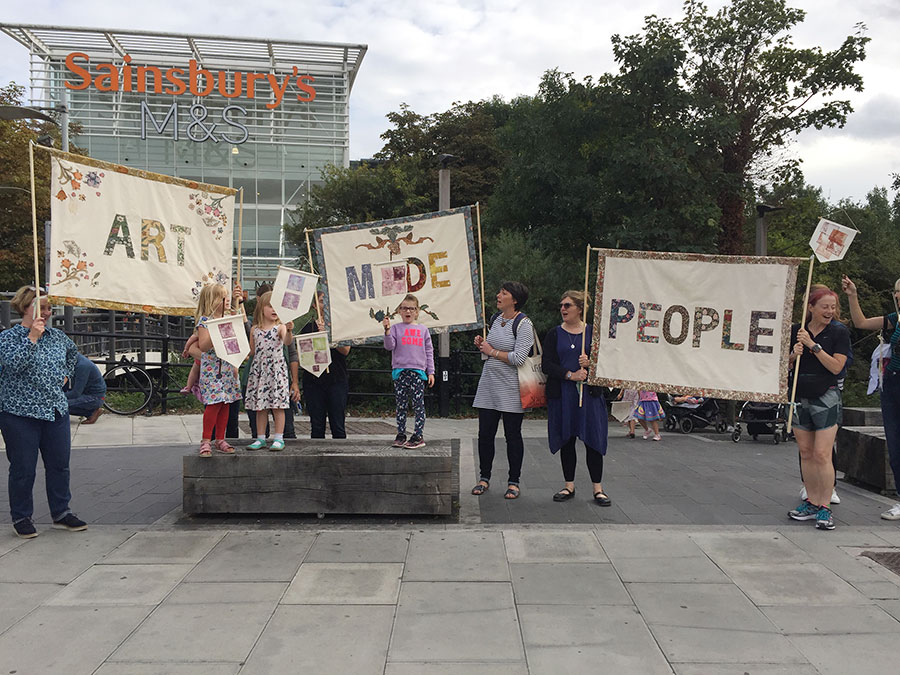
Art Made People
Calico, repurposed Liberty and Morris fabrics
In 2018, Made in Merton processed with the banners from Merton Abbey Mills, where the Liberty works were located, along the Wandle to Sainsbury’s, which stands on the site once occupied by William Morris’s Merton Abbey Works.
Portia Dadley
I retrained in the creative arts after a career in editing and management. After completing the City Lit fine art course in 2014, I established community arts group Made in Merton with the aim of reinvigorating Merton’s textile heritage, connecting people and place. We run sewing and block-print workshops, with participants often creating work that is incorporated into artworks that are displayed in community venues. We are currently working on The Merton Story, which celebrates Merton’s diverse cultures, co-creating textile artworks with the disabled, LGBTQIA+, Korean, Polish, Ghanaian, Caribbean, and south Asian communities.
Making Merton: textile activism past and present
For centuries, the River Wandle was used for textile processing and production, powered by strong communities of makers. One of those communities developed at Merton Abbey Works, where William Morris worked with local people to turn his designs into printed and woven textiles. The creativity that the workers of the Wandle put into making textiles continued beyond the workroom and helped to achieve social change. Ironically, their stories have been obscured by the “great man” view of history—Morris would wish the achievements of his workers to be recognised—and there is scope for an article in Text that sheds light on the social, political and creative networks that supported a thriving textile community at Merton Abbey.
People who live in Merton today are connecting with their textile heritage and are using it to come together to make change locally. Community arts group Made in Merton grew from a project in which local people made banners bearing the words “art”, “made” and “people”—referencing Morris’s belief in “art made by the people and for the people”. They cut letters from second-hand Morris fabrics and sewed them onto calico—a textile once processed along the Wandle. They marched along the river with the banners chanting “Art made people! People made art!”—a manifesto that proclaimed a connection between local makers, creative enterprise and social transformation.
That manifesto is being put into practice. Made in Merton worked with disability rights group Merton CIL to make banners—again using calico and Morris fabrics—to promote the independence and inclusion of Deaf and Disabled people in Merton. The banners are used by access champions to promote change, including a campaign to install changing places toilets in local venues.
Print + Stitch Together is a series of free block-print and sewing workshops that puts a contemporary twist on Merton’s textile heritage. The aim is to create a community of makers, with participants learning how to sew and block-print functional textiles such as tea towels and tablecloths that they can use at the community centres where the workshops are held. The process of making segues into a process of making social connection, with people coming together to craft high-quality items that can be used every day in the places where they are made—a stand against materialism, individualism and throwaway culture.
Print + Stitch Together was piloted at the North East Mitcham Community Association in 2025. Made in Merton is seeking to expand the project, and has secured agreement to deliver it at three more community centres. The group has begun the process of becoming a community interest company, which would confer a statutory commitment to social goals. It wants to upskill Print + Stitch Together participants so that they print and sew textiles for retail, with profits reinvested for community benefit. The group is inspired by Fine Cell Work and Stitches in Time, which use textiles to transform lives. It would welcome support from the Textile Society, perhaps with a call-out in the Members’ Forum in News, to make design contacts and realise its ambition to revitalise Merton’s textile heritage and make lasting connections between local makers, creative enterprise and social transformation.
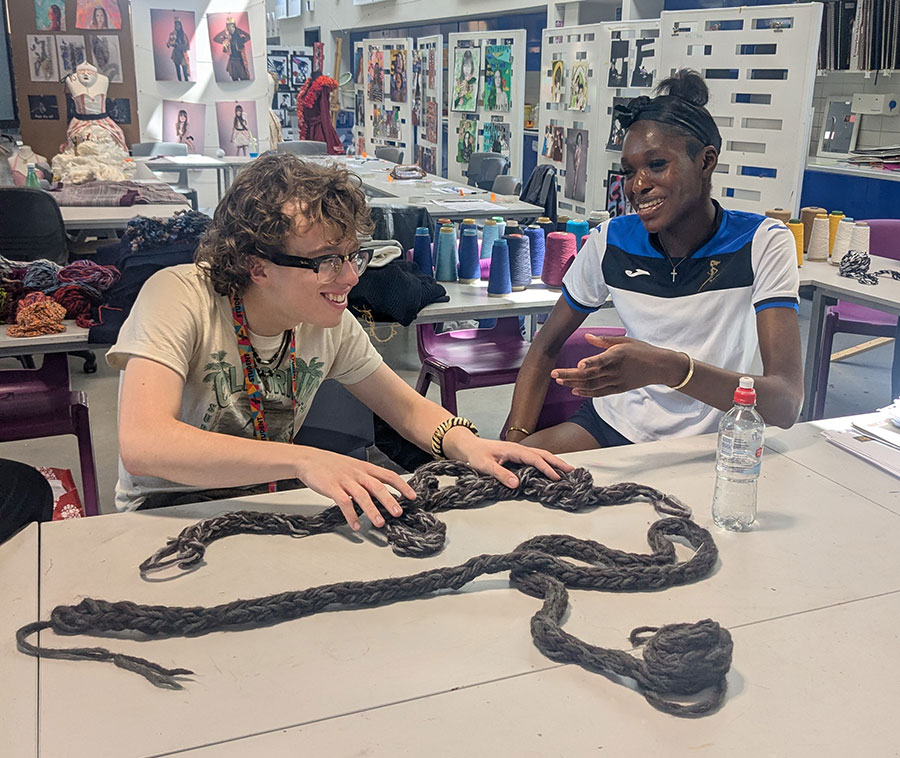
Reya: Re-use Yarn
Participants in secondary education participating in industry-focused, waste reduction research as co-researchers.
Image Credit: Elizabeth Gaston, 2025
Elizabeth Gaston
I am an associate professor at Northumbria University, where I leads the knit curriculum. My research uses Knit Thinking, a maker methodology that combines tacit craft knowledge and explicit technical knowledge expressed through physical making, to explore complex problems with a focus on responsible design. My work has been presented in exhibitions and conferences globally and published widely in book chapters and journals.
My current research, Reya: Re-use Yarn, investigates scalable methods for reducing pre-consumer waste in high-volume knitwear manufacturing. An educational resource enabled Gen Z consumers to participate as co-researchers, placing design education at the centre of industry-focused, research-through-design.
Education! Education! Education!
Nelson Mandela said, “Education is the most powerful weapon which you can use to change the world” He wasn’t talking about textiles, but his sentiments stand. To avert a global environmental crisis, we need new approaches to product development and an education system that supports innovation.
Knit is a valuable zero-waste manufacturing process, enabling the production of 2D and 3D forms with placed fabric functionality. It is increasingly recognised for its versatility across industrial sectors and used for innovation in architecture, medical textiles and biotechnologies. However, this soft engineering is not taught in depth outside of tertiary fashion/textiles education due to time/resource/skill/perception limitations, creating gatekeepers of knowledge.
This position paper reports on the development of a knit education curriculum for and with secondary schools, developed with teachers, students and industry professionals.
Building on earlier work, which had developed a low-tech, no-cost colouration process that enabled manufacturers to produce new yarns from waste to reduce landfill. The project worked with sixth-form students, key consumers of fast fashion, to extend the research and develop a communication tool to present to the knitwear industry. However, it was recognised that whilst students have a good understanding of sustainability concerns and over-consumption, they lack the knowledge necessary to co-design knit outcomes.
An appropriate knit curriculum, delivered in two, three-hour masterclasses, was co- developed with A-Level teachers and knit professionals, using a knit-thinking/thinking- through-making approach. Introducing a rapid, low-technology, knit method enabled its adoption without schools’ financial or temporal investment. It was trialled with three UK secondary schools.
Following the knit masterclasses, the teaching materials were refined into an innovative knit teaching resource, presented as a self-led masterclass guide. This is available in hard copy or as a printable PDF. Whilst the in-person masterclasses were trialled with fashion and textiles students, who provided a strategic access to schools, the guide is broader with examples from outside of knitted garment production, enabling its use across curricula and age groups. The long-term goal of the project is to produce graduates who understand the benefits of knit as a construction process outside of the apparel industry.
Position
Knit is a valuable, sustainable production process with broad application. However, it is routinely absent from secondary education due to financial/temporal/skill limitations and a general decline in the currency of creative education. It is critical to address this through support from Higher Education and the knitwear industry.
A main tenet of the Textile Society is education, currently evidenced in student and professional support/awards and research dissemination. However, utilising the Textile Society’s diverse membership, could this be expanded to include advocacy for creative education, including the value of textile design, at the highest governmental level? Additionally, a call to arms from members could be a catalyst for the development of resources for primary and secondary schools, expanding the reach of the Textile Society and ensuring its continued relevance and membership.
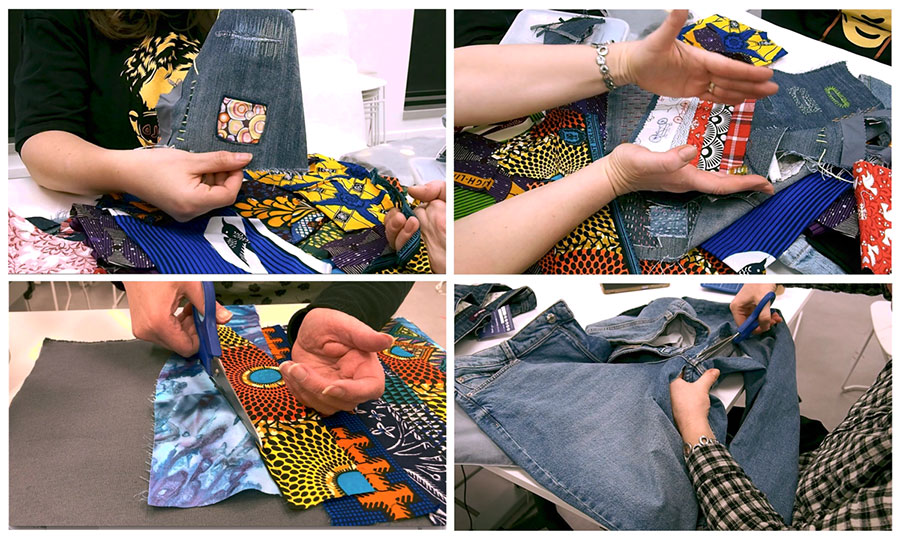
Volunteers from the Ealing Repair Cafe demonstrating the teaching samples and textile techniques used in their workshop sessions
Lucie Hernandez
I am an artist and researcher whose practice explores repair, material culture, sustainability, and digital craft through textiles, collaborative making, and participatory engagement. I investigate repair as both a creative methodology and a social practice, using acts of making to foster care, creativity, and more sustainable relationships with everyday materials. Through workshops, community projects, exhibitions, and research-led collaborations, I create opportunities for people to share knowledge, develop practical skills, and reflect on the environmental and cultural value of repair.
Repair as Resistance: Artist-Led, Community-Based Approaches to Textile Sustainability
The act of repairing clothes can be viewed as a form of everyday resistance to the overproduction, disposability, and waste associated with contemporary consumer culture. Repair practices extend the life of garments and inspire more attentive, considered relationships with textiles, in contrast to fast fashion systems characterised by high production and obsolescence. This paper argues that artist-led, community-based approaches to clothing repair offer powerful models for sustainable change that combine practical skill-building with critical reflection. Additionally, it proposes that the Textile Society is well positioned to support, expand, and legitimise these practices by connecting them to broader histories, networks, and forms of public engagement.
The act of repairing clothes can be viewed as a form of everyday resistance to the overproduction, disposability, and waste associated with contemporary consumer culture. Repair practices extend the life of garments and inspire more attentive, considered relationships with textiles, in contrast to fast fashion systems characterised by high production and obsolescence. This paper argues that artist-led, community-based approaches to clothing repair offer powerful models for sustainable change that combine practical skill-building with critical reflection. Additionally, it proposes that the Textile Society is well positioned to support, expand, and legitimise these practices by connecting them to broader histories, networks, and forms of public engagement.
We have seen the re-emergence of repair in recent years in grassroots initiatives such as repair cafés, maker spaces, and community workshops. These activities provide highly effective, informal spaces for knowledge exchange, where participants share skills, stories, and resources. These initiatives encourage social connection and collective responsibility, situating sustainability as a shared, lived experience that is centred around engagement in material practices. However, despite their growing visibility, these activities often remain localised and under-recognised within formal textile discourse. There is a need to better connect these practices to institutional frameworks that can support their development, documentation, and wider dissemination.
The Valorising Artist-Led Innovation through Citizen Engagement (VOICE) project provides a useful framework for addressing this gap. VOICE positions artists as catalysts for innovation within the intersection of art, technology, and society, emphasising participatory and practice-based approaches to ecological challenges. Working within this context, my work as a VOICE artist involved me collaborating with members of the Ealing Repair Café, exploring how textile repair can contribute to the ongoing circulation of materials, reducing waste and decreasing consumption. Set up in 2019, the Ealing Repair Café hosts regular monthly meetups, where a group of dedicated volunteers encourage and support the local community to learn how to value and mend their clothes.
In conclusion, repair offers a powerful lens through which to rethink relationships between people, materials, and systems of production and consumption. Artist-led, community-based approaches demonstrate how repair can be both practical and transformative, combining skill development with critical engagement. However, to realise the full potential of these practices, there is a need for greater connection, visibility, and support. The Textile Society, with its expertise, networks, and commitment to textile culture, is well placed to play a central role in this process. By embracing and advancing repair as a key area of focus, the Society can help to bridge past and present, local and global, public and private to contribute meaningfully to the development of more sustainable textile futures.
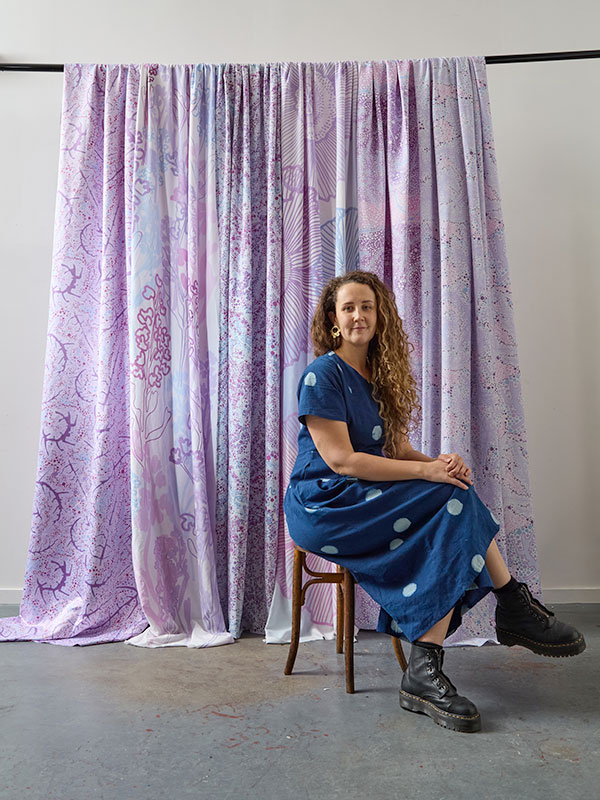
Ruth Lloyd
I am a London-based textile design researcher specialising in sustainable colour, textile printing and microbial colour systems. My doctoral research (2026) was undertaken at Central Saint Martins, UAL, within the Living Systems Lab, and was funded by and developed in partnership with Colorifix, a UK microbial dyeing biotechnology company. The research developed industrial textile printing processes using colourants produced through microbial fermentation, translating living colour into reproducible print protocols, colour systems and development tools. My wider practice works across printed textiles, biotechnology and colouration technology to support more sustainable textile manufacturing.
From Fields and Fossil Fuels to Fermenters: Microbial Colour as the Third Textile Colour System
Textile colouration has historically developed through two dominant systems: plant- and insect-derived natural dyes and petroleum-derived synthetic dyes. While these systems enabled the expansion of textile production, both present structural environmental limitations. Historical natural dye production required extensive land, labour and chemically intensive processing, while contemporary synthetic dyes provide efficiency and colour performance at the cost of toxic chemistry, high water consumption and widespread environmental pollution.
This paper proposes microbial colour as the emergence of a third system of textile colouration, produced through microbial fermentation rather than agricultural cultivation or petrochemical synthesis. Drawing on historical analysis, contemporary scientific research and practice-led experimentation undertaken within an industrial biotechnology environment, the paper positions microbial colour not simply as an alternative dye source but as a fundamentally different model of colour production.
Microbial colourants are produced by microorganisms such as bacteria, fungi and algae through controlled fermentation processes. Rather than detailing the technical processes involved, the paper focuses on the broader structural characteristics of fermentation-based colour production when compared with natural and synthetic dye systems. These include rapid production cycles, minimal land requirements and the potential use of renewable feedstocks.
Using comparative analysis of the three colour systems, supported by industrial observations and experimental textile printing research, the paper examines how microbial colour may operate within existing textile manufacturing frameworks while enabling new forms of bio- based colour production.
The paper concludes by considering how the Textile Society could support the responsible development of microbial colour within the textile field. As a charity dedicated to advancing public education in textile art, design and history, the Society is well positioned to support the documentation of emerging microbial colour practices, facilitate dialogue between textile designers, scientists and industry, and provide forums through which new bio-based colour
systems can be critically examined within textile scholarship and practice.
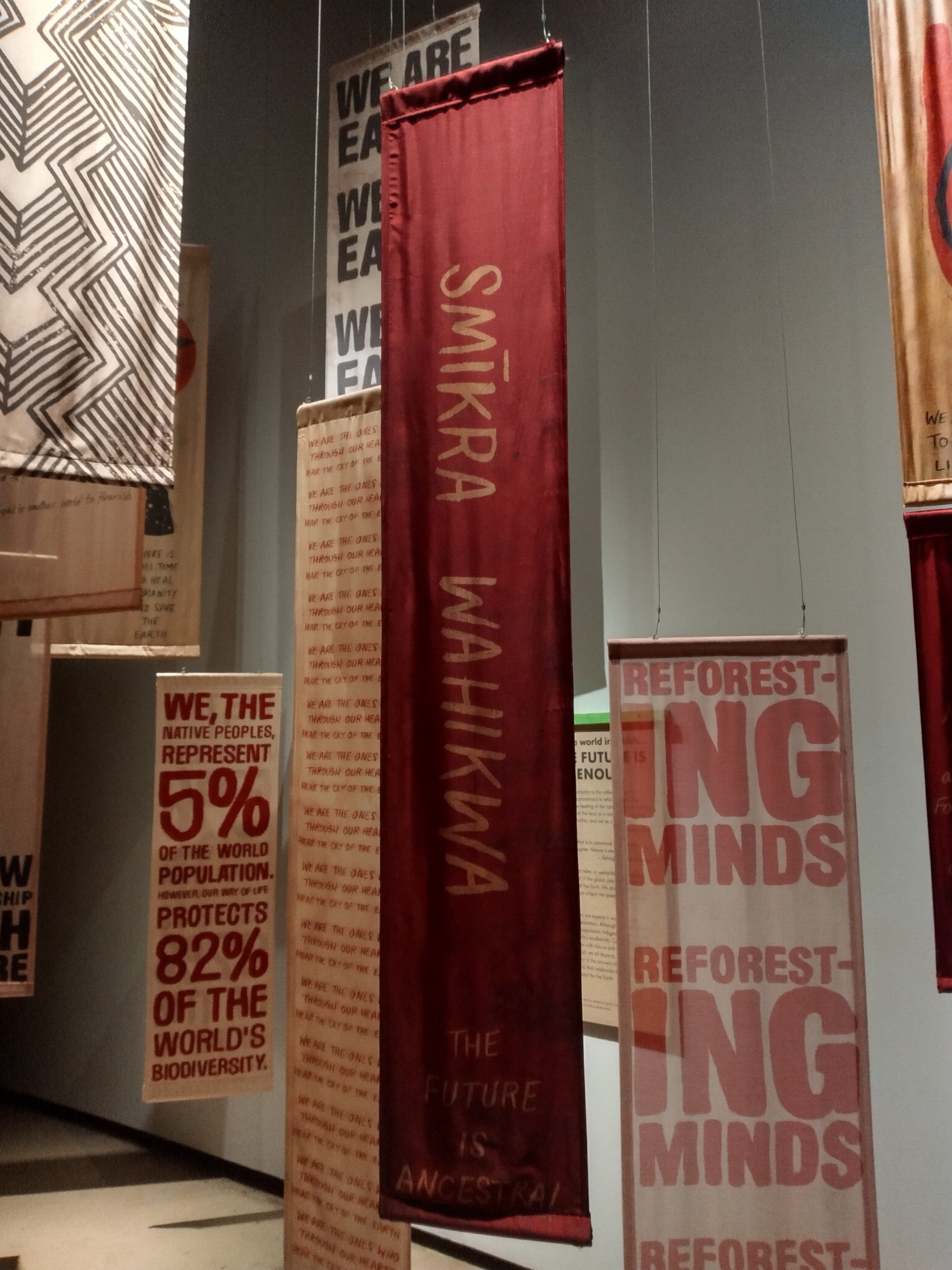
Installation view of Our Time on Earth at Barbican Art Gallery (May – August 2022)
Image credit: Hester Mauduit
Hester Mauduit
I am a doctoral researcher at University of the Arts London, working across the Centre for Fashion Curation and the Centre for Sustainable Fashion. My doctoral project investigates sustainable curatorial approaches and climate action in fashion exhibitions in the UK and The Netherlands. As Research Associate at the Barbican Art Gallery, I supported the development of Dirty Looks: Desire and Decay in Fashion (2025). I have previously worked at the Fashion for Good Museum in Amsterdam, where I co-curated What Goes Around Comes Around (2024), and recently curated the exhibition Future Fashion Landscapes for the British Textile Biennial 2025.
Fashion Curation and Future-making
This paper responds to recent scholarship which positions museums as futuring agents and exhibitions as vehicles of “future-making” (Schatzki 2002, Shamiyeh 2025). It argues that fashion museology has, to date, been overlooked within this discourse, despite emerging curatorial practices in fashion exhibitions which exemplify their futuring potential. Firstly, the paper surveys the key strands of thought on museums and futuring, particularly analysing the International Council of Museums’ 2022 museum definition which included core focuses of “sustainability” and “service to society.” This definition represents a significant shift in thinking on the purpose of museums and the exercise of that purpose via long- and short-term programming (Brulon Soares and Bonilla-Merchav 2025).
By tracing the emergence of the future in museum theory, the survey outlines the understanding of future-making in the context of museology and reveals a lack of theorisation of fashion as a discipline of future-making. In response, the paper begins to establish a chronology of recent fashion exhibitions in the UK and beyond which have addressed urgent questions regarding our collective future, acknowledging that more extensive research remains to be conducted. Finally, this paper invites members of the Textile Society to reflect on fashion’s ability to address ideas including building alternative futures, fostering radical imagination, More Than Human design, utopianism and more. It proposes that the Textile Society dedicate an issue of TEXT journal to the question of fashion museology, calling on scholars to address the theoretical gap of fashion and future-making, demonstrating thought leadership and establishing fashion exhibitions’ social responsibility with regard to future generations.
The paper builds on initial findings of my doctoral research on sustainable curatorial practices and fashion exhibition-making.
Works cited
Brulon Soares, B. and Bonilla-Merchav, L. 2025. The Museum Definition Handbook. ICOM.
Schatzki, T. R. 2002. The Site of the Social: A Philosophical Account of the Constitution of Social Life and Change. Pennsylvania State University Press.
Shamiyeh, M., ed. 2025. Practices of Future-casting: Ways of sharing imagined tomorrows. Birkhäuser.
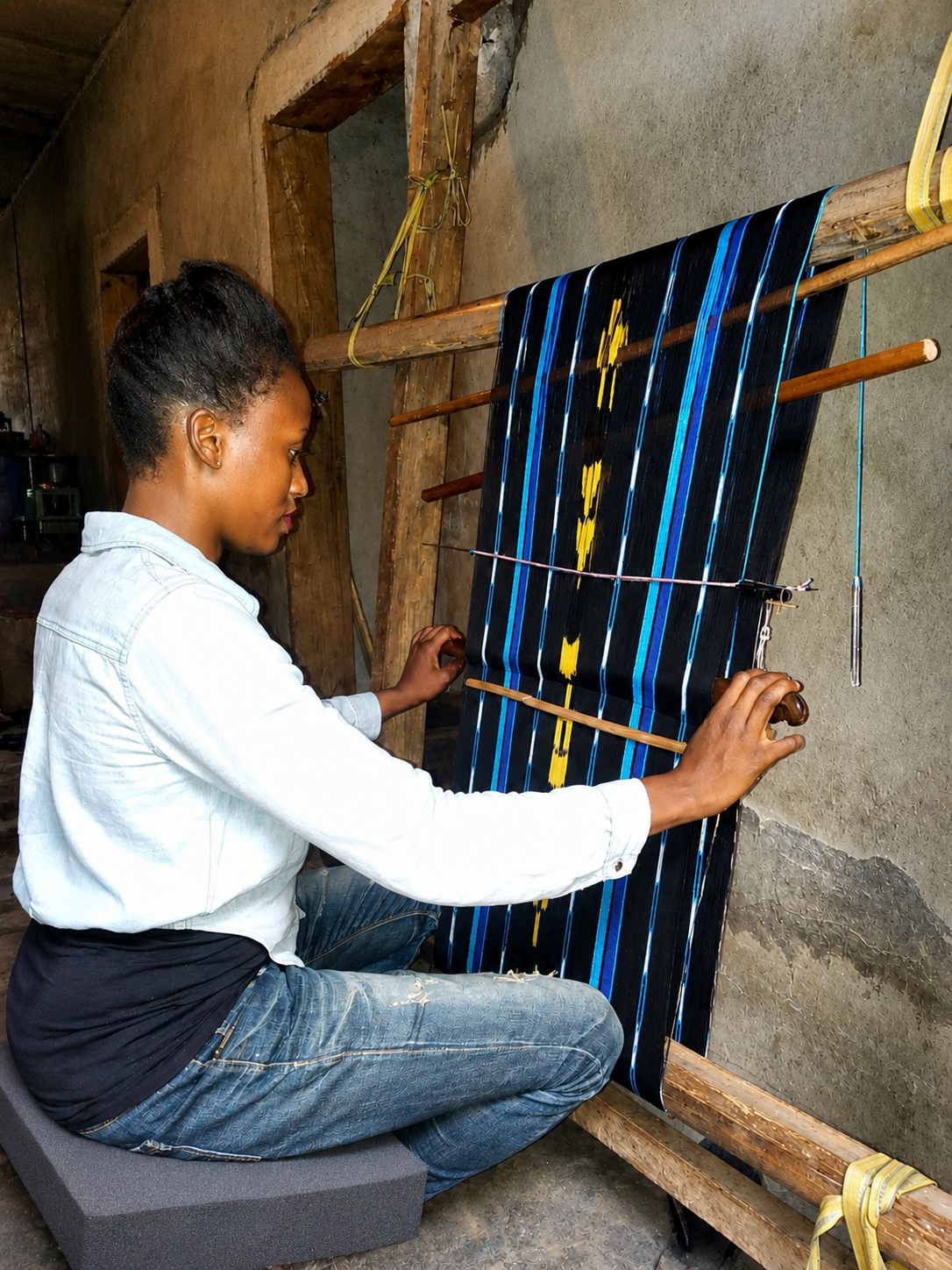
Mabel Okuta
I am a textile artist, researcher and educator specialising in Itowoji, the handwoven fabric of the Igarra people of Edo State, Nigeria, and a craft passed down through my own weaving family. I hold two Master’s degrees in Textiles, from the University of Benin and the University for the Creative Arts, UK, and bring over two decades of weaving experience to a practice that bridges craftsmanship and academic inquiry. I have lectured, exhibited internationally, and published research positioning Itowoji as intangible cultural heritage and, as an Itowoji ambassador, I am affiliated to the Society of Nigerian Artists.
From Preservation to Activism: Advocating Living Textile Heritage Through Practice-Based Research
This position paper draws on MA practice-based research at the University for the Creative Arts, Epsom, to argue for a shift in textile advocacy from preservation-as-documentation toward activism-through-making. Using the Itowoji fabric of the Igarra (Anetuno) community in Nigeria as a case study, the paper positions textiles as “living heritage”—dynamic systems sustained through embodied practice.
As a researcher and Igarra heritage ambassador, I operate as a bridge between indigenous traditions and contemporary design. Traditionally, Itowoji—distinguished by its colour and ikat design—is worn by women as wrapper, headgear, and shawl with lace Buba, and by men as Agbada. This research challenges these ceremonial boundaries through the construction of a contemporary corset, reframing the fabric as a form of “wearable activism” that evolves its cultural language for global relevance.
Technical friction points encountered during practice—including the loss of Ikat motifs in loom transitions and the failure of natural dyes on synthetic yarns—highlight structural limitations affecting heritage crafts today.
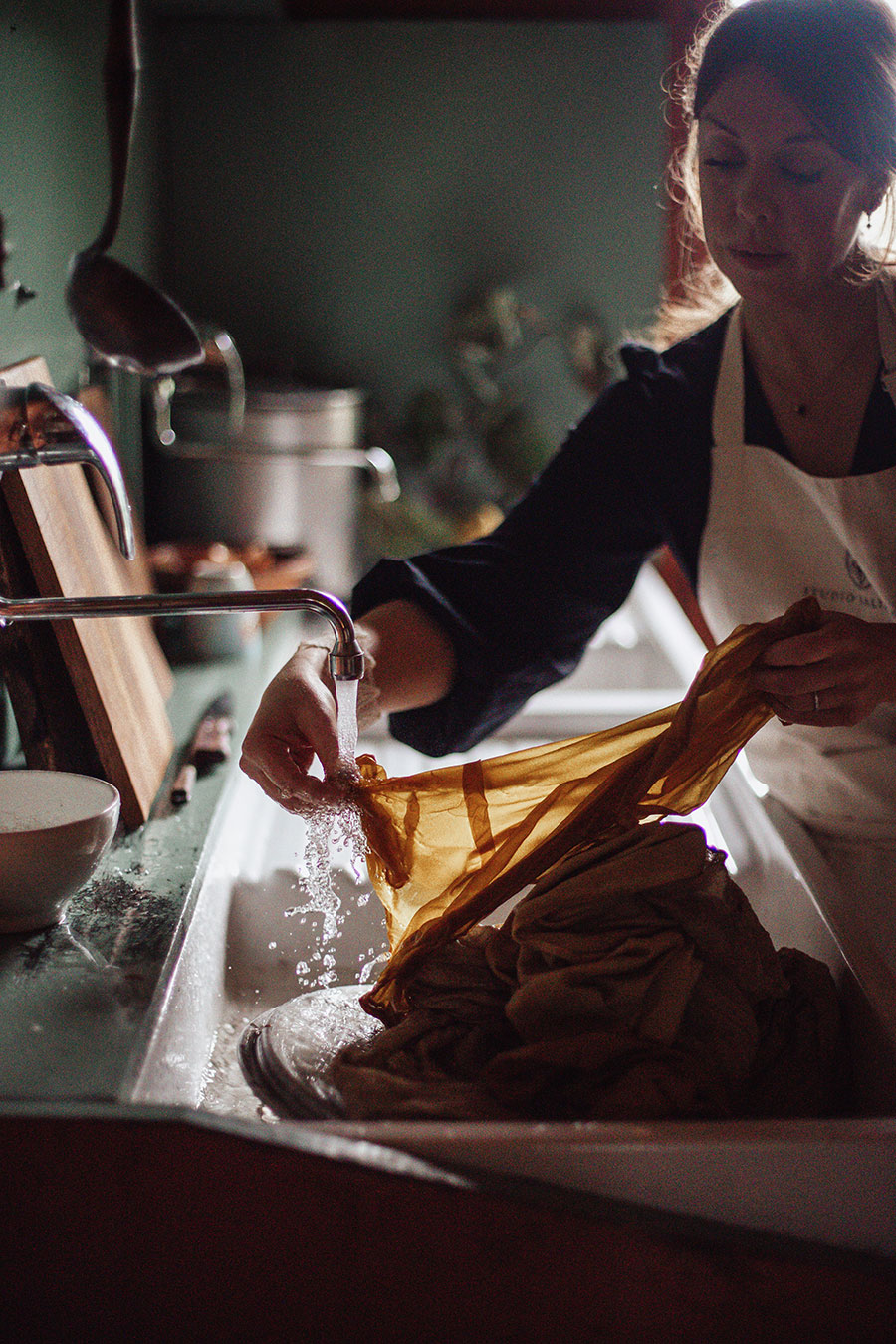
Studio process using cultivated calendula pigments grown within the grounds of an 11th-century château in France. Development work for a site-responsive medieval dye garden project.
Image credit: Sarah Pardoe, Studio Salinger
Sarah Pardoe
I am Sarah Pardoe, a textile artist, researcher and founder of Studio Salinger, where I explore botanical colour and the relationship between landscape, memory and making. Through fine art textiles, writing and site-responsive practice, I create work rooted in natural materials and place. My practice is informed by more than twenty-five years of international experience across textiles, fashion, colour and material development, together with family roots in a European textile atelier dating back to the 1900s. Working with natural materials, historical and contemporary research, I investigate how textile practice sustains our relationship with the natural world, carrying the stories of place, culture and time across generations.
Colour from the Land
Natural Dye, Textile Practice and the Future of Cultural Knowledge
For most of human history colour was not manufactured but discovered. It was drawn from roots, leaves, bark, minerals and insects, each pigment carrying the memory of the landscape from which it emerged. Through the work of the human hand — gathering, dyeing, spinning and weaving — these colours became embedded within cloth, transforming textiles into records of place, community and time.
This paper forms part of an ongoing body of research and artistic practice exploring the relationship between natural colour, landscape and textile knowledge. It considers how colour functions not as surface, but as a living expression of place — shaped by soil, climate and local practice, and realised through processes of making that connect human and natural systems.
Natural dye and textile processes reveal that colour emerges through relationships: between land and plant, plant and fibre, fibre and hand. The understanding required to work with these materials is tactile and embodied, learned through close attention to the natural world. Such understanding cannot be separated from the experience of making.
When colour enters fibre, it becomes story. Each dyed textile carries the memory of the land from which its colour came, holding histories of cultivation, use and exchange. Through textile practice, knowledge of land and its people is carried across generations. Techniques of making have long identified places and communities, sustaining identity through material, technique and colour.
As natural colour and textile practices become increasingly detached from the landscapes and traditions from which they emerged, what they carry is at risk of being lost — a diminishing of inherited systems rooted in long-standing relationships between people and the natural world.
In an increasingly digital landscape, such practices offer vital forms of human–nature collaboration, sustaining ways of working that connect us to the real. The colours derived from plants are not neutral; they hold and carry the histories of the land, shaped over time. These stories can only be preserved through continued engagement — through the act of making itself. Emerging tools such as AI may support documentation, but cannot replace knowledge gained through direct experience.
If these practices are lost, we lose not only techniques, but ways of knowing — and with them, the stories that connect us to land and one another through time.
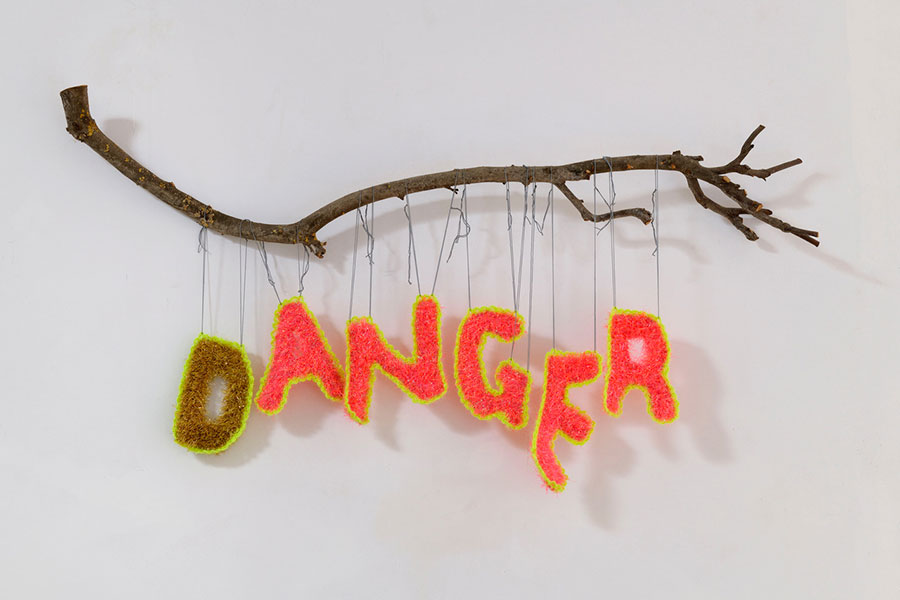
D-ANGER, 2023, hand knitted yarn and crocheted mohair suspended from branch, Approx. 850 x 1500 x 1200 mm.
Photographer: Douglas Atfield.
Freddie Robins
I am a maker who challenges the perceptions of knitting, refusing to accept and comply with the subordinate position that the discipline holds. My practice crosses the boundaries of craft, art and design. I predominantly produce work for public exhibition, most recently ‘Apotropaic’, Douglas F. Cooley Memorial Art Gallery, Reed College, Portland, Oregon, USA as the Stephen E. Ostrow Distinguished Visitor in the Visual Arts. My work is held in private and public collections including the Government Art Collection, Victoria & Albert Museum, Crafts Council and Kode, Bergen. I am Professor of Textiles at the Royal College of Art, London.
Thirteen Reasons not to study Textiles
What would be the point of presenting a paper that extolled the value and importance of studying textiles as a practice-based subject. Everyone in the room already understands this. We would be sitting in one big echo chamber, which we are in danger of anyway as no one joins the Textile Society who doesn’t love textiles. Instead, I will take a subversive and antagonistic approach and talk about why you shouldn’t study textiles. Inspired by the American art historian and writer, Julia Bryan-Wilson, and her Eleven Propositions in Response to the question: “What Is Contemporary about Craft?” (The Journal of Modern Craft, Volume 6 – Issue 1, March 2013 pp. 7-10) I will explore thirteen, (unlucky for some), negative statements about the studying of textiles.
Examples of these are as follows:
- Do not study textiles because few people outside of its immediate orbit value it creatively, materially, financially or academically.
- Do not study textiles because the industry has historically been associated with poor working conditions and labour exploitation, which continues in many developing countries today.
- Do not study textiles because it is a poorly paid industry where you will never be named, paid or celebrated as highly as the designers who use your textiles will be.
- Do not study textiles because you will be stuck with your student debt forever and the interest on your loan will impoverish you for life.
- Do not study textiles because the industry has a significant negative environmental impact and a tendency to green wash.
- Do not study textiles because if you end up in the industry your work will involve little creativity and you will be predominantly undertaking administration and repetitive and tedious screen-based tasks, which will all be taken over by AI anyway.
- Do not study textiles because courses at art schools and universities are constantly closing evidencing the lack of investment and interest in the subject.
- Do not study textiles at school (GCSE/A-level) because it requires significant commitment, consistently hard work and only girls take it. You cannot cram it or wing it.
In this paper I take a subversive and antagonistic position. I am a committed textiles practitioner – a maker, artist, craftsperson, knitter, designer, collector and Professor of Textiles at the Royal College of Art, London. I would usually extoll the importance of studying textiles. In this paper I won’t.
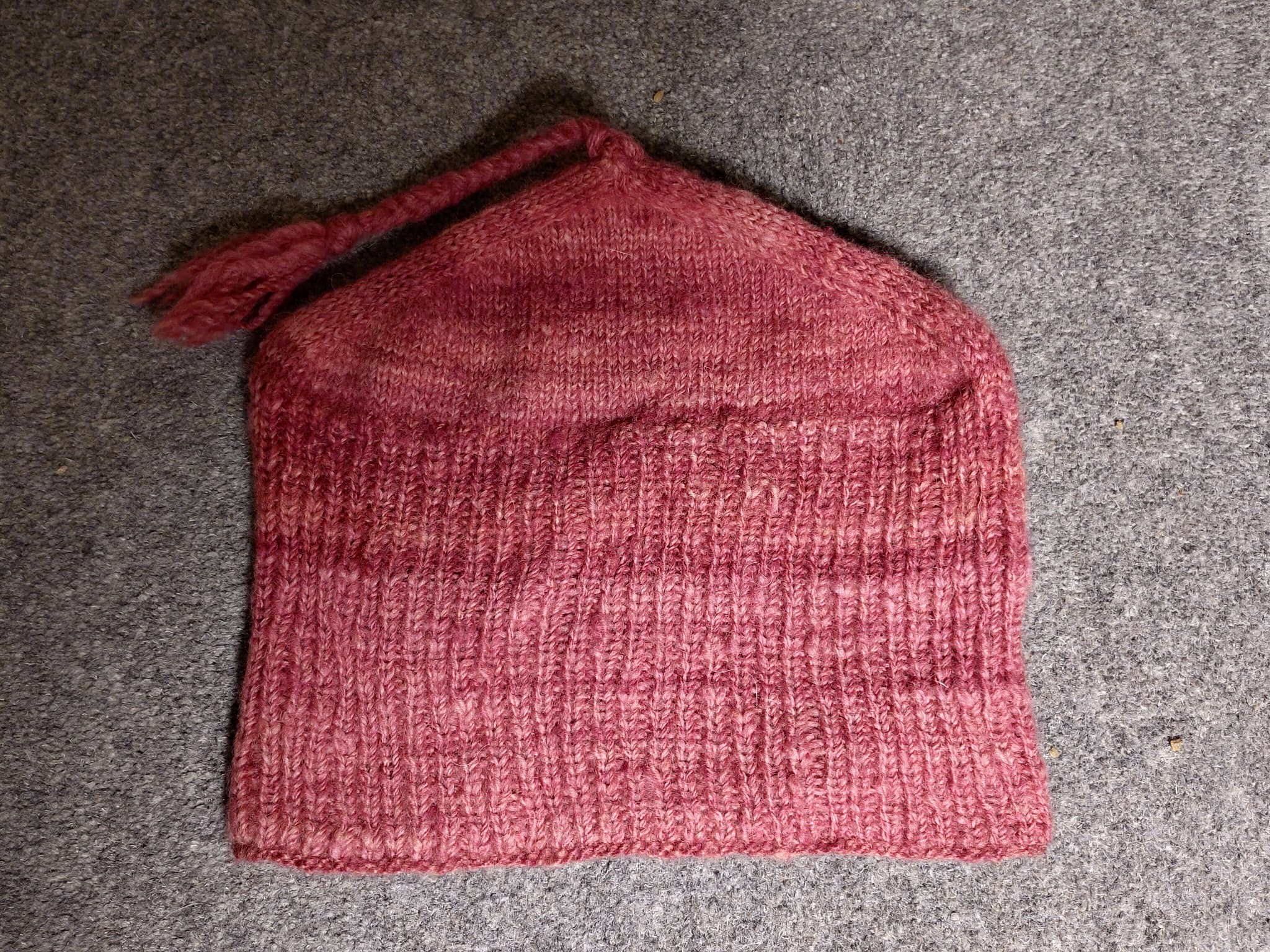
Melt the ICE hat. Hand spun, dyed and knitted by Isobel Holland.
Image credit: Isobel Holland
Angharad Thomas
A geographer and textile designer, I have taught at all levels and worked in small and large scale knitwear production. A lifelong knitter and maker, I was an editor of the celebratory Women and Craft (Virago 1987) while my PhD examined the role of design in sustainability in Welsh textile production (2011). Recent research has been focused on the design, making, and history of finely knitted gloves, resulting in the Holy Hands project (https://kemeresearch.com/gloves/about) and A Knitter’s Guide to Gloves (Crowood 2023). I have volunteered in the collection of the Knitting & Crochet Guild of the UK since 2012.
Handknitting: Soothing, skilled, everyday, economical, traditional. All of the above?
Handknitting, probably dating from the 12th century has a scant history, with few dated artefacts extant. Used to make lowly socks and high-status garments worn by the rich, in the 20th century it became a means of clothing families economically. Globalisation changed this through cheap imports and handknitting fell out of fashion. However, since the events of 9/11 in 2001, a revival in handknitting has occurred along with the development of the internet and sites like Ravelry but this has a different profile from that of the previous century.
I advocate for a more nuanced, rigorous approach to handknitting securing its history and status in the textile world. Knitted textiles often appear to be the poor relation of woven and embroidered textiles and few have been collected or preserved and studied. The Textile Society could support work and activities that add to the body of knowledge about knitting and knitted textiles which could have many aspects: historic, scientific, inspirational for contemporary practice.
Handknitting has many skill levels, but a contemporary discourse identifies handknitting being ‘soothing’, or ‘relaxing’ . In 2002 Montse Stanley wrote ‘Knitting has an image problem’ and this perhaps has not gone away.
Activism in handknitting is on-going; from the possibility of passing on information encoded in handknitting stitches during war time to the current Melt the ICE hats, see illustration. I make the case that in researching handknitting in all its manifestations, from its origins and history to current practices, products and discourses is a form of activism in its own right.
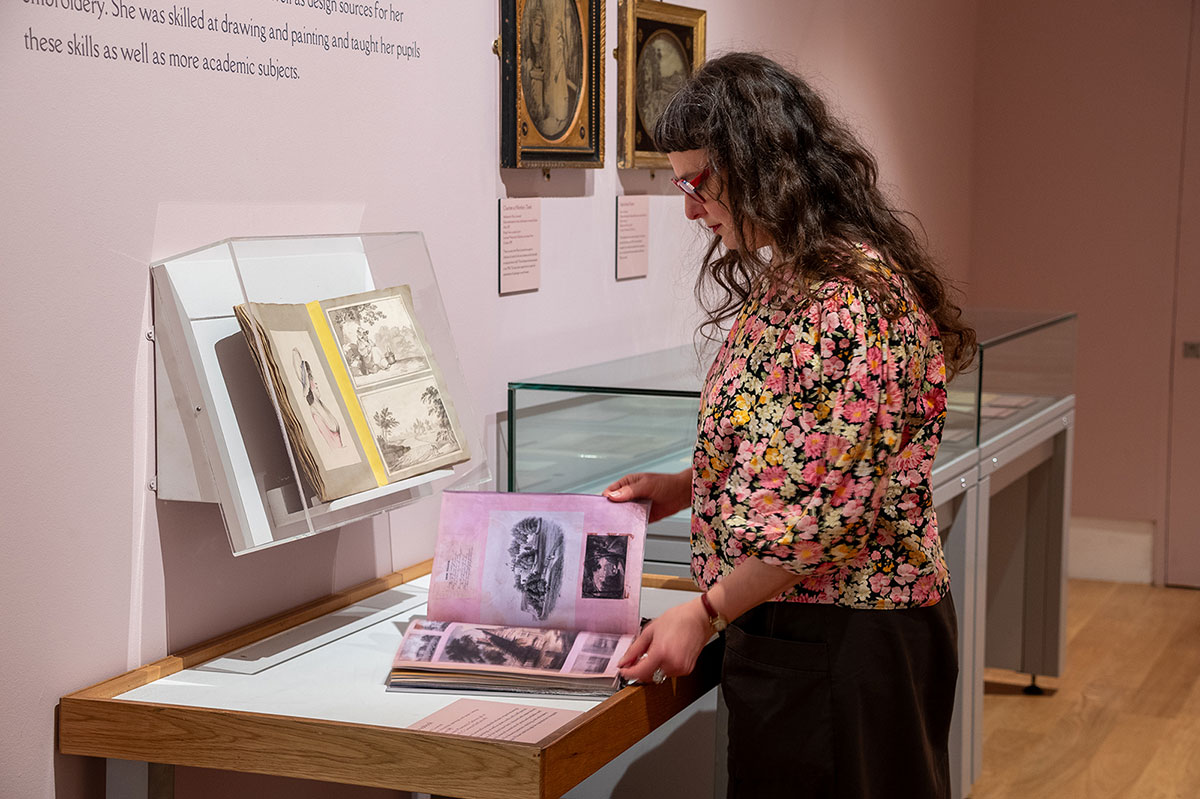
Ruth Singer in her exhibition Mary Linwood; Art, Stitch & Life, Leicester Museum & Art Gallery, 2026.
Photo by Paul Lapsley
Ruth Singer
I am a textile artist and researcher, interested in hidden stories of care, sewing practices and the history of sewn objects. I work across arts, museums and academic projects including exhibition curation and textile history research. My first career was in museums and this continues to influence my practice and projects today. I have created multiple solo exhibitions, written several books, have been artist in residence & project artist in universities, libraries, archives, museums and schools as well as working with arts organisations. I run public engagement projects, online programmes and support artists on professional and creative development.
Shared histories of textile making
While I have many ideas around the themes of advocacy & activism, I have chosen to focus on the area I have the most experience of. After more than 30 years working first in the museum sector and later as an independent artist and textile historian, I feel passionate about the connection between museums and artists. In my museum career I worked with contemporary and heritage craftspeople to illuminate museum objects through making practice and since leaving the museum profession over 20 years ago, I have chosen to research within museums, archives and heritage buildings to inform my artist practice. In all the years of my working life, I have seen how artists and makers find it difficult to connect with and access museum collections and expertise and almost impossible to share their knowledge and skills of making practice with the museum.
The haptic knowledge of textile makers is still marginalised and under-valued in research, publications and exhibitions and museums have not been able to easily collaborate and connect with makers who can both be inspired-by and transform our understanding of the textiles within collections. This work is happening in pockets, particularly involving academic research but it should be accessible and indeed encouraged for artists and makers to both access and illuminate the textiles and fashion collections in museums.
My proposal for the Textile Society is around removing some of those barriers for textile museum collections and makers to connect and collaborate. The Society is perfectly placed to form a bridge between artists, designers and makers and the museums and institutions which hold the collections. I would like to see the Society hosting an online forum for interested parties, organising regional networking events bringing artists and museums together. The Society might later apply for funding to co-ordinate funded placements for artists in museums, more extended artist residencies and joint research projects that build on these networks. This could include exhibitions and public engagement programmes to share the knowledge and skills gathered through the activities. Alongside this proactive and co-ordinated approach, the Society could also look to gather evidence and previous research and make this accessible to interested artists and museums.
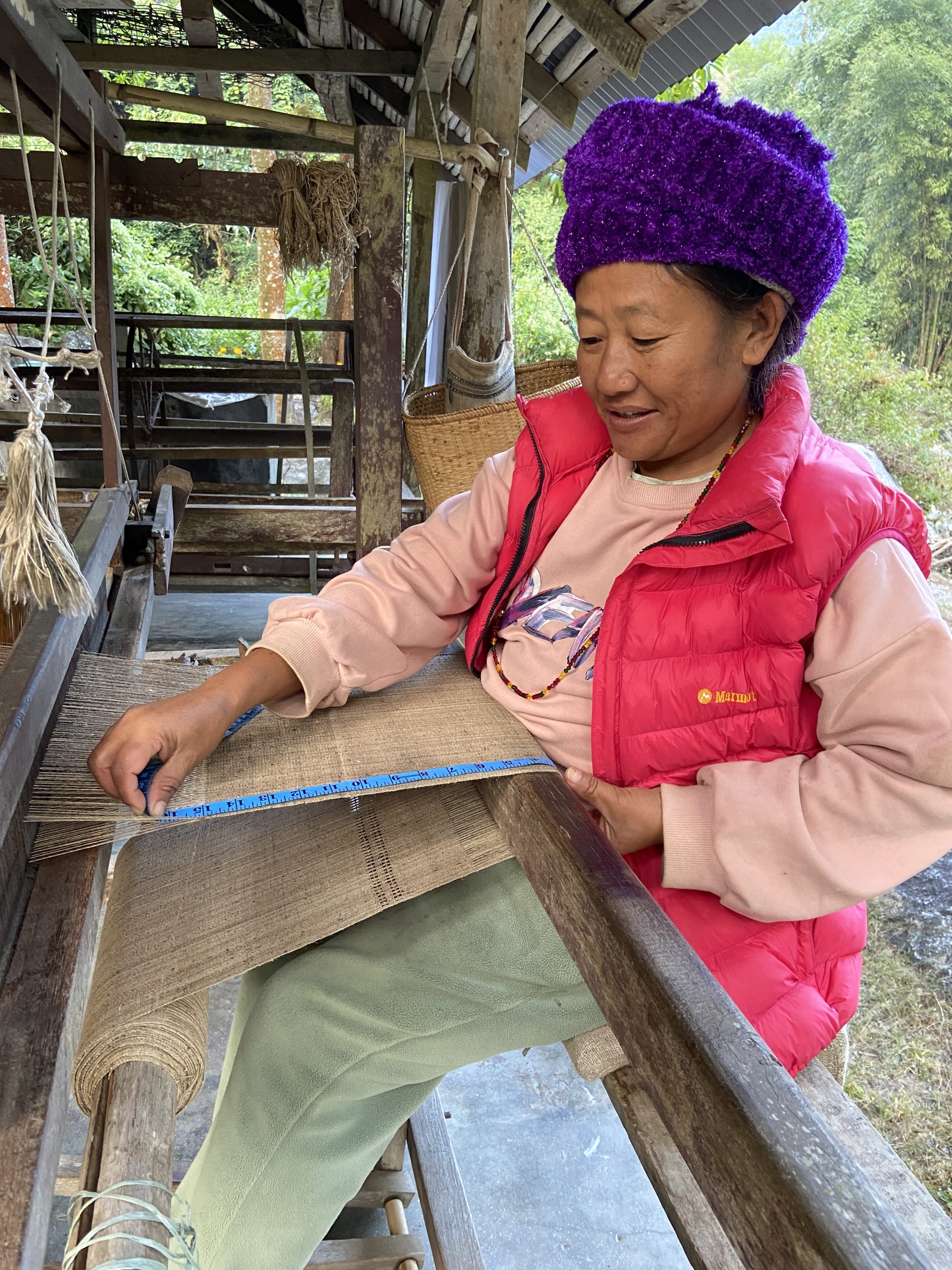
Allo weaver
Image credit: Louise Surowiec
Louise Surowiec
I received my MA Constructed Textiles from the Royal College of Art in 2003, during which I was the recipient of an award set up by Susi Dunsmore to support textile makers in east Nepal. Twenty years on, I have returned to the Royal College of Art as a PhD candidate to research the textile-led social impact work of Susi Dunsmore, examining it through a contemporary lens. I also teach textiles, art and design at primary and secondary school level, and deliver practical workshops to various community groups, including a weekly Nepali women’s craft group.
Advocating for textile makers in the Global South: Insights drawn from the textile-led social impact work of Susi Dunsmore (1926-2017)
From the early 1980s onwards, Susi Dunsmore advocated for textile makers in poor, rural communities of east Nepal. She understood that weaving and knitting could provide sustainable forms of income generation for some of the poorest people in the world. Operating within the holistic framework of an integrated rural development project, Susi Dunsmore proffered assistance to textile makers in the development of their handicraft for a wider market whilst maintaining their traditional designs, skills and methods.
As a society committed to the study of the history of textiles but also looking towards future advocacy and activism, the Textile Society and its members will likely find Susi Dunsmore’s work of interest. It draws attention to important and current concerns around balancing innovation with the preservation of traditional practices whilst avoiding the tendency to romanticise or ‘other’ the maker and their craft. It provides an interesting case study in changing approaches to how we research and write about global textile traditions and raises the important question of how we can give a voice to textile makers of the Global South today in a globally inclusive way.
Through my position paper I will offer a brief introduction to Susi Dunsmore’s work in east Nepal, touching upon her involvement with dhaka cloth weaving and allo (Himalayan giant nettle) production, and summarising the significance of her work and writing to the study of the history and design of textiles. I will then outline key insights drawn from my PhD research, which may help to inform the way the Textile Society advocates for textile makers of the Global South.
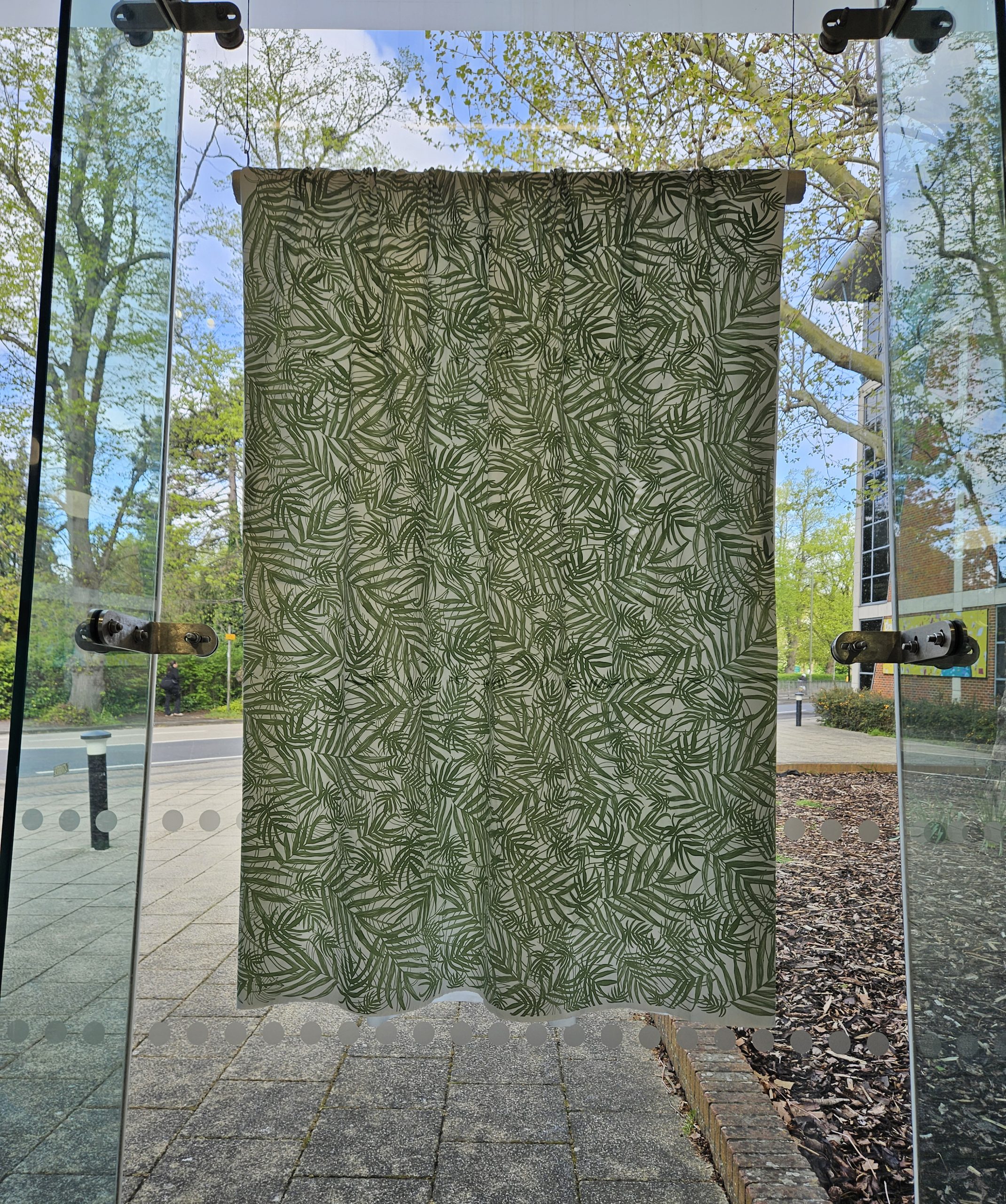
Image: Screen printed textiles, using Colour Earth’s natural dye screen print paste ‘Regen Ink’
Displayed at the University for the Creative Arts ‘Green Week’ exhibition 2024
Meredith Wood
I am a researcher, designer and Co-founder of Colour Earth, a regenerative colour research and development studio, primarily exploring the intersections of science, colour, fashion and farming. Since completing my MA at the Royal College of Art, my research has investigated the environmental impacts of the fashion and textile industries, whilst exploring regenerative alternatives. My practice specialises in screen printing and natural dye processes, with a focus on developing sustainable colour systems. At Colour Earth, I work alongside Aurelie and Chris, who bring their expertise in bio-design, material science, soil health and chemical analysis to form a collaborative and multidisciplinary research based approach.
From Contaminated Land to Colour that Heals: Regenerative Dyes as Textile Activism
Colour production in the textile industry remains structurally dependent on synthetic dyes, when natural dyes are used, extractive mining and toxic mordants pollute this process. Both options contribute to ecological degradation, water pollution and carbon emissions. Simultaneously, the UK faces a legacy of post-industrial and mining-contaminated land, which remains underused and environmentally hazardous. This paper argues that these two crises are not separate problems, but a shared opportunity for regenerative textile activism.
Drawing on collaborative research with Colour Earth, this position paper proposes a model in which plants that are pigment producing, as well as metal-hyperaccumulating, are grown on contaminated land. These plants simultaneously heal soils through phytoremediation and generate natural dyes. Rather than treating soil remediation and textile colour production as separate areas, this approach repositions textile colour as agents of ecological repair. Metals taken up from the soil into plant biomass become chromatic resources, while the phytoremediation process reduces reliance on virgin metal extraction for mordants and pigments.
This paper explores regenerative dye systems that constitute a form of material activism. They challenge the linear, extractive ‘take, make and waste’ model of fashion supply chains and instead embed circularity, land stewardship, and local production within textile practice. By transforming polluted landscapes into sites of regenerative colour production, the textile field can move beyond symbolic sustainability and toward infrastructural change.
Advocacy, therefore, must extend beyond natural colour choices to land policy, soil regeneration, and industrial ecology. Textile professionals, researchers and institutions, alongside The Textile Society, are uniquely positioned to influence these transitions through material innovation, cross-sector collaboration, and public engagement.
Reframing colour as an ecological relationship, rather than a chemical input, invites a new politics of making, one in which textiles participate directly in environmental restoration. This paper advocates for the future of textile colour grounded in regeneration, with dye functioning as instruments of environmental justice and ecological repair.
The Textile Society is uniquely placed to support this vision by fostering interdisciplinary partnerships, promoting regenerative dyes through research, dissemination and public-facing programmes such as funding and exhibitions, as well as championing policy engagement that connects textile practice with land restoration and environmental justice. This could lead to the Textile Society playing a critical role in advancing this model, embedding regenerative colour practices within the industry for the future and positioning textiles as agents of environmental restoration.
By Meredith Wood, Chris Ferguson & Aurélie Fontan – Colour Earth
Click here to change this text